Imagine recommending a colleague for a role you know is about to disappear. You describe the team accurately. The salary is real. Every sentence survives scrutiny. Only the reason they might refuse is missing.
Afterwards, you defend yourself by repeating what you said. Your colleague objects to the understanding you allowed them to leave with. You are examining your sentences. They are examining the choice those sentences helped produce.
The freedom inside an agreement
In Cicero’s hypothetical case, a merchant arrives in famine-struck Rhodes carrying grain. He knows that other grain ships are approaching. His buyers do not. Must he tell them before selling at the prevailing price?
Diogenes of Babylonia defends the merchant’s right to pursue his advantage without volunteering every useful fact, provided he fulfils his obligations and makes no misrepresentation. Antipater argues that the relationship between seller and buyer remains part of a wider fellowship between human beings. Commercial terms cannot exhaust what they owe each other. Cicero favours disclosure.
The disagreement is difficult because each position protects something worth keeping.
Diogenes protects a person’s legitimate separateness. My knowledge, effort and interests do not become common property simply because someone else could benefit from them. A life in which every advantage must be surrendered would leave little room for privacy or independent purposes.
Antipater asks what happens to that defence when another person’s ignorance becomes the condition of our success. The buyers choose the transaction, but the merchant knows something that might change their judgment. Their agreement does not settle whether he has treated them fairly; the circumstances in which he obtained it remain open to examination.
That is the philosophical difficulty inside the everyday phrase “they agreed.” Agreement tells us that a person said yes. It does not, by itself, tell us how faithfully the situation they understood corresponded to the one we knew.
A conceptual illustration of Cicero’s hypothetical grain trade: what is visible to the buyer, and what remains undisclosed.
When silence starts doing work
We cannot disclose everything. Nor can we become responsible for every inference another person makes. Understanding is always incomplete, and communication would become impossible if honesty required eliminating every ambiguity.
But some misunderstandings are incidental. Others are useful to us.
Return to the job recommendation. Your colleague explains that they want stability. You now know which belief is carrying them towards agreement. If you keep praising the team while avoiding the fact that the role is about to disappear, your silence helps preserve that belief.
My view is that this creates a responsibility beyond answering questions accurately. You are helping to form a decision while withholding a reason to reconsider it. Your colleague is still choosing, but part of the basis for that choice is being managed for your benefit.
An appeal to literal truth treats each sentence as detached from what the speaker understood it would accomplish. Yet we speak to secure commitments, purchases, forgiveness or confidence. An account of honesty that examines only the words leaves their intended work unexamined.
The limits of what we owe
There is a danger in taking this argument too far. We can become paternalistic, deciding that another person’s choice counts only when it reflects everything we think they ought to know. Respecting their judgment also means accepting that they may understand the risks and choose differently from us.
The obligation I am proposing is narrower: when we invite a commitment, we should not knowingly depend on a material misunderstanding that our own communication sustains.
That leaves room for legitimate privacy. A manager may be unable to explain a colleague’s absence without revealing confidential medical information. But confidentiality does not require promising that the team will remain fully staffed. The manager can limit the assurance, acknowledge uncertainty, or decline to make a promise they cannot defend.
Sometimes that will cost us the agreement. That cost is precisely why honesty cannot be reduced to a communication technique. If another person’s judgment matters only while it produces the answer we want, we have granted it very little authority.
The harder task is to give them enough clarity to refuse us, without claiming responsibility for making their decision on their behalf.
When you say you were completely honest, do you mean your words were true, or that the other person could understand what they were agreeing to?
Seven readings and three talks to examine evidence, judgment and the reasons behind our responses.
7 reads +3 talks +2 charts
01
Seven worth reading
A small collection. A wider view.
The selection opens with organisations confronting change and the architecture behind GitHub. Further in, Matt Abrahams returns to the limits of disclosure, while Jason Cohen asks what would make us reconsider advice we trust. Each offers a different reason to look more closely.
01 / Product
How to Handle Disruptive Change
Commoncog (Cedric Chin)
≈ 19 min · Current
93/100
Why do organisations recognise disruption and still fail? Cedric Chin examines how debt, cash pressure and internal strain can exhaust the time needed to adapt. Financial resilience buys room to develop a workable response; it does not identify the winning technology. Read this for the distinction between seeing a threat and being able to survive it.
GitHub separates immutable Git objects from mutable references that require coordination. The redesign makes ordering proportional to the state that actually needs it, rather than the volume of stored code. Independent branches benefit most; pushes to the same reference still compete. The reported gains come from internal tests, with further efficiencies still planned.
Not knowing an answer and being unable to disclose it call for different responses. Abrahams works through both: a specific follow-up promise for uncertainty, and an explanation of constraints when disclosure is restricted. Reframing must return to the question; it should not conceal an inconvenient answer.
Polished sentences cannot supply a missing reason to write. Adam Mastroianni argues that readers respond to a particular person’s investment in particular words, not just fluent prose. Revision therefore reaches into motive and thought. He leaves future machine capabilities uncertain: this is a direction for human writing, not proof of a permanent advantage over AI.
When every failure is blamed on implementation, a framework becomes difficult to test. Jason Cohen calls this the Precision Fallacy and argues for adapting or replacing methods under local conditions. Ask what evidence would count against the advice itself. His broader claim that frameworks usually fail is a belief; the shirt analogy illustrates rather than measures it.
A story can fit the facts while allowing almost any of its details to change. Deutsch contrasts an adjustable seasonal myth with an explanation constrained by geometry and independent observations. Try the same distinction when a persuasive story seems able to explain every outcome. This is a philosophical test, not a proof of truth.
C. S. Lewis examines the desire to enter a circle whose attraction depends on others remaining outside. The danger lies in what belonging is for: shared work and friendship differ from insider status. Boundaries can protect competence, confidentiality or limited capacity. This essay asks when crossing one becomes more important than anything worth doing together.
Cicero’s probabilia offers judgments strong enough to guide action without claiming final certainty. This account of Academic Skepticism treats revision as compatible with commitment: follow the stronger argument while remaining answerable to new evidence. The interpretation matters. It presents Cicero as a philosopher with a distinctive position, rather than simply a transmitter of Greek thought.
What causes an emotion is different from what gives us a reason to feel it. Kagan separates fear of dying, being dead and dying prematurely, then examines what fear, anger and sorrow each presuppose. His conditions for appropriate fear are contestable and rely partly on earlier lectures. This is philosophical argument, not clinical advice.
New Research Tests Whether AI Models Know Their Own Thoughts
quantamagazine.org
≈ 10 min · Discovery
80/100
Can an AI detect a disturbance inside itself without knowing what it contains? Quanta examines experiments separating those abilities. Follow-up work supports detection more strongly than knowledge of content. Neither finding establishes consciousness or subjective experience. The useful distinction is between responding to an internal change and representing it as one’s own thought; even “introspection” remains disputed.
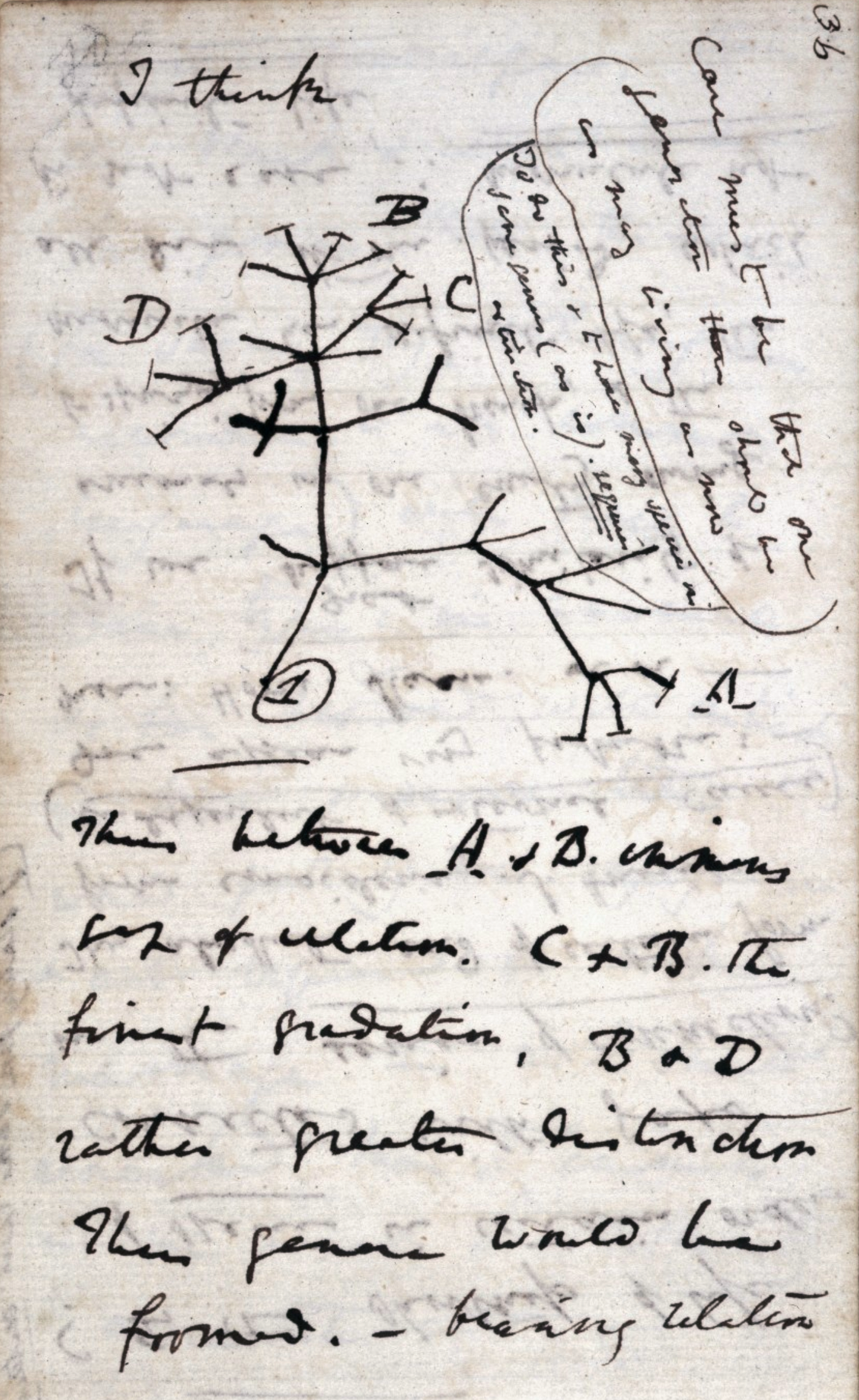
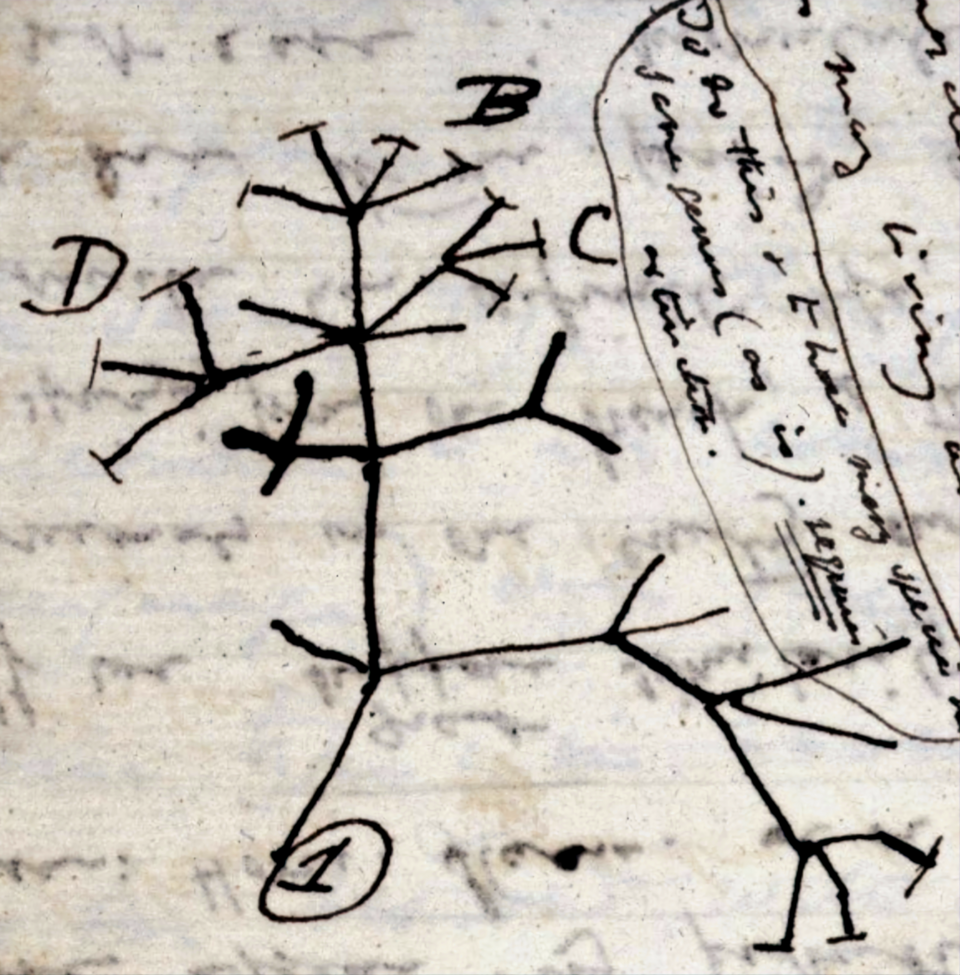
Charles Darwin, Notebook B, p. 36 (1837). Public-domain facsimile and crop via Wikimedia Commons.Look at the ends: crossbars mark survivors; unmarked ends represent extinct lineages.
Look past “I think,” the famous words above Darwin’s 1837 sketch. Some branches end with a short crossbar; others end without one. The unmarked ends represent extinct lineages. The crossbars mark survivors.
The drawing was doing more than connecting living things to shared ancestors. Darwin was working through how new species could appear while others disappeared. The dead ends belong to the explanation: remove them and the history changes.
This was exploratory work, before his formulation of natural selection. Our reading of the page: a convincing family tree can still mislead if it shows only survivors. When a company, a discipline or a family tells its story, look for the branches that stop. What has disappeared from the account?
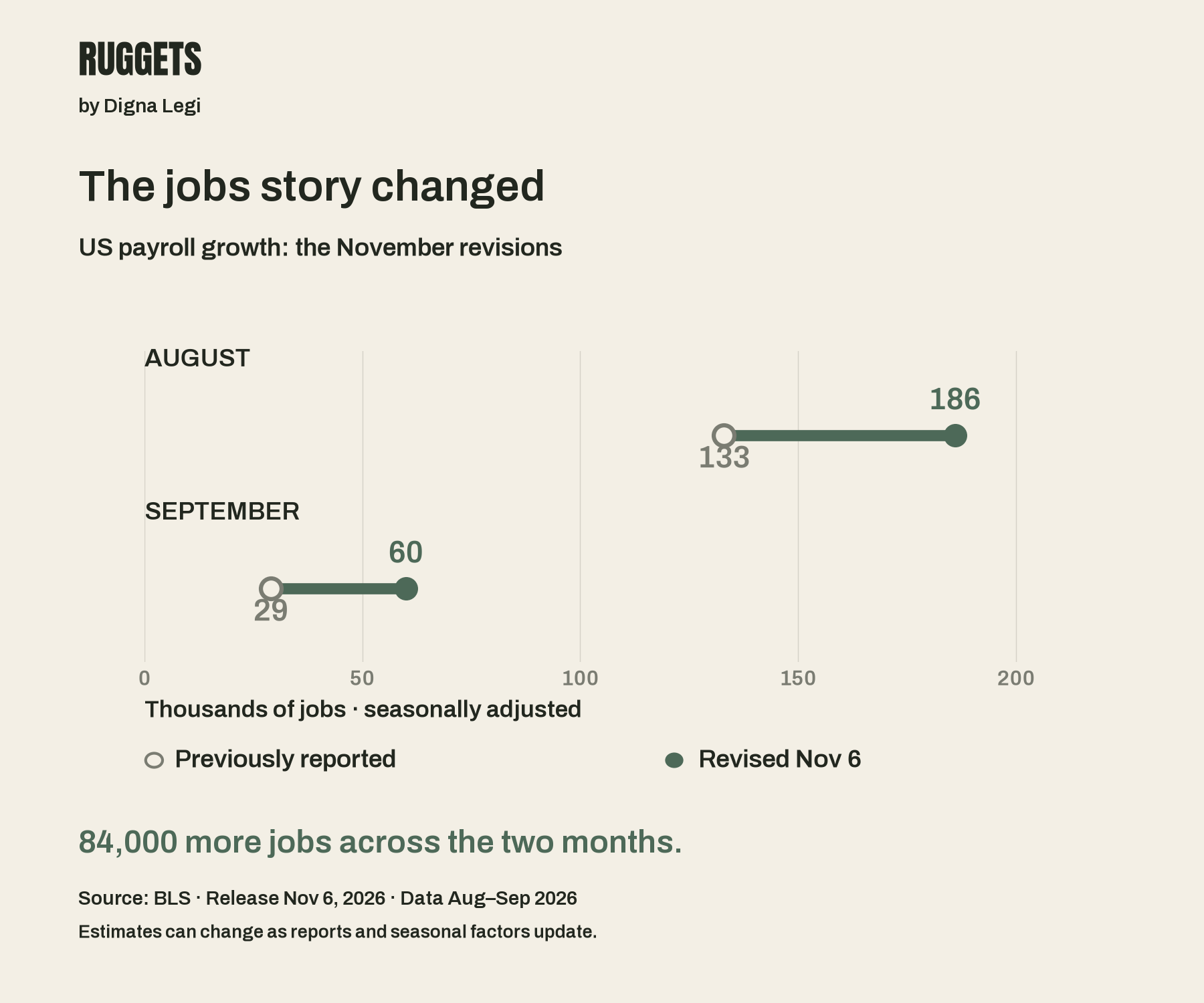
The takeaway. The November release added 84,000 jobs to the previously reported gains for August and September. A monthly headline is an estimate that improves as more employers report, not a final verdict on the economy. Before changing your outlook, revisit earlier months alongside the new number. These revisions strengthen this particular two-month picture; they do not establish the next month's direction. Seasonal adjustments and later revisions can change the estimates again.
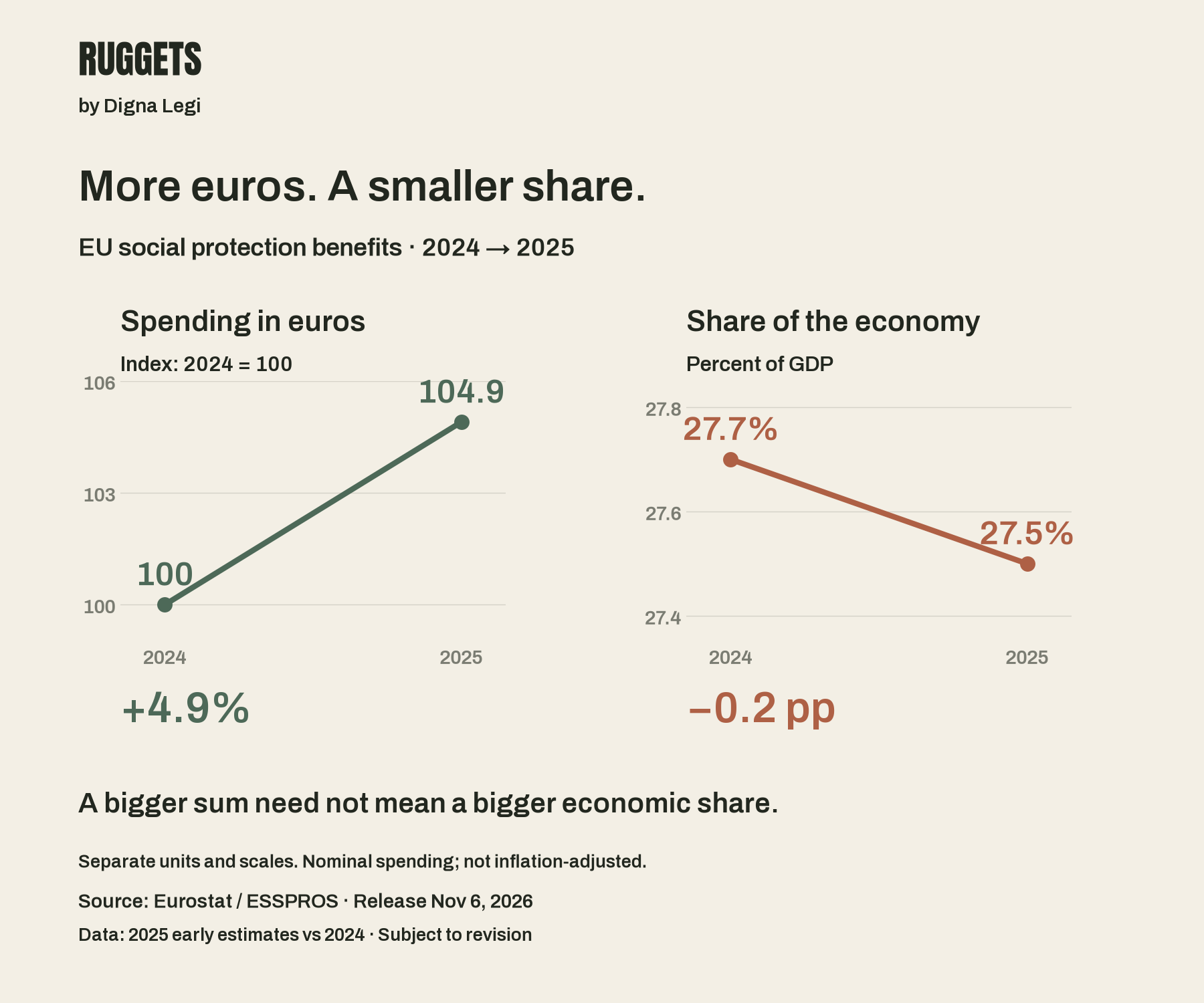
More euros. A smaller share.
Eurostat · Published 2026-11-06 Data: 2025 early estimates, released November 2026 · Source data ↗
The takeaway. EU social protection spending rose 4.9% in euros in 2025, yet its share of the economy fell from 27.7% to 27.5%. A larger cash total does not necessarily mean a larger economic commitment: the denominator matters. When a budget headline announces an increase, ask what it is being compared with. Neither measure establishes whether people received better support; these preliminary estimates do not adjust for inflation, population change or differences in need.
A modern visual interpretation of responsibility without ownership of another person’s response.
You apologize to a friend and wait for forgiveness. Insisting on reconciliation turns an apology into a demand; withdrawing because you cannot secure it abandons what remains yours to do.
Epictetus distinguishes our judgments and choices from outcomes that depend on other people. The distinction concerns moral responsibility, not a technique for getting results. Your friend's response cannot establish whether you acted honestly, because honesty belongs to your conduct, while forgiveness belongs to theirs. Making your integrity conditional on their approval gives someone else authority over the kind of person you will be.
This is a demanding account of freedom: relinquishing a claim over the outcome while remaining answerable for your action. Here, that means acknowledging the harm and making amends without treating either as payment for reconciliation.
What would doing your part require if approval never arrived?