Several pieces this week ask what becomes visible when we change how we look. Bret Victor moves between broad patterns and concrete behavior; Jo Freeman exposes the informal power that survives the rejection of formal rules. Our look at Sundback’s fastener adds a physical counterpart: a simple gesture depends on carefully arranged parts. Read together, they invite attention to the relationships a tidy surface can conceal.
01 / Product
Lost confidence
Jason Cohen — Long Form
≈ 12 min · Current
94/100
A confidence score can make an ambitious project look less attractive precisely because its outcome is harder to predict. In this account of product prioritization, that is a problem with the framework, not evidence that the smaller project deserves to win. The alternative starts with uncertainty: which choices remain sensible when a credible probability cannot be assigned?
The available responses serve different purposes. A portfolio can make incremental results more reliable; an asymmetric bet accepts uncertainty in pursuit of an unusually valuable outcome. Preserving future options can justify extra work in a mature company while costing an early venture essential speed. Choosing among these approaches requires an argument about the kind of result a company needs, rather than another decimal place in its confidence estimate.
A broad view can reveal a pattern while concealing the behavior that would explain it. The ladder of abstraction makes movement between these views part of designing a system: representations spanning many possible values expose relationships, and concrete instances show what those relationships mean in practice. Intuition develops through that movement, alongside the design itself.
Neither level provides a sufficient vantage point on its own. Remaining with individual observations can hide a recurring pattern; staying with aggregates can make an explanation seem complete before its particulars have been examined. The argument concerns systems whose behavior emerges from rules people have written, rather than algorithms whose internal rules remain unseen. Within that boundary, changing the representation becomes a way of asking a more revealing question of the same system.
A raincoat decision tree makes the calculation visible: compare the best choice without a forecast with the best state-dependent choices after a perfect forecast, then subtract. Before buying another test, ask whether even perfect information could justify its cost. This is an upper bound, not a promise that a real test is useful. Its probabilities and payoffs must fit the decision; a cost below the bound does not establish value.
Parsing “Can” from “Should”: How Netflix's Product Team Got Thousands of Creatives to Trust an AI Overhaul
First Round Review
≈ 19 min · Current
94/100
Mckenzie Lock’s Netflix account begins with a judgment that technical capability cannot settle: which parts of creative work should change, and which human decisions deserve protection? Her approach connects AI adoption to desired experiences and broken workflows, making roles and tradeoffs explicit before treating automation as the objective. The work of defining the change is organizational as well as technical.
A measurable improvement can still leave a difficult choice about where complexity belongs. Naming that choice, making a concrete bet, and testing it against business outcomes gives colleagues something more specific to assess than enthusiasm for a model. Netflix’s scale and capacity for selective testing matter here. The account offers a developed example of negotiating those choices, without implying that smaller organizations need to reproduce its entire process.
Without formal leaders, a group can still be governed by the people who control its relationships and information. Jo Freeman argues that refusing explicit structure leaves these networks intact while making their authority harder to challenge. Members may have influence over one another without any agreed procedure for authorizing that influence, questioning it, or withdrawing it.
Informal relationships are unavoidable, and Freeman does not regard them as inherently harmful. Loose discussion groups can serve their purposes well. Trouble arises when a group needs coordinated decisions but continues to treat the absence of rules as protection from power. Her argument makes accountability a question of organizational design: how can members exercise control over authority that already exists, without imposing more formality than their shared task requires?
Chi shows a projected display and a fishing-line gesture rig made from everyday materials. The second prototype helped his team reject an awkward interaction. Name one experience your proposal depends on, then build the cheapest proxy that lets someone actually try it. These are first-person development examples, not controlled evidence that prototyping makes every team faster. Testing an interaction does not validate market demand, privacy or social acceptance.
Something can strike us as true before we have formed an argument for it. The account developed here treats that immediate presentation as a possible reason for belief, much as perception can offer a reason to believe that something is present. Its force depends on how a situation is apprehended, rather than on a distinctive sensation accompanying the intuition.
That distinction leaves room between dismissing intuition and obeying it. An initial reason can be defeated by further evidence; having grounds for a belief does not guarantee its truth. Everyday intuitions and philosophical cases can therefore belong to the same inquiry about justification. The difficulty lies in understanding what an immediate seeming contributes to judgment while keeping that contribution open to correction.
A failed project need not make a failed person. Setiya traces the temptation to confuse them to a particular demand on life: that it form a coherent story, moving toward an outcome that explains the whole. He separates the claim that people naturally narrate themselves from the stronger claims that a good life must possess narrative unity and that its subject must tell that story.
Once those demands are distinguished, a life can remain intelligible and worthwhile without becoming a quest with a decisive climax. Setiya’s target is not every form of storytelling. It is the pressure to make unity and linearity conditions of living well. A story can help someone understand a life while still being too narrow to deliver a verdict on its value.
John Dunlosky / Faculty of Science - McMaster University
Remember it again, on another day
Dunlosky turns notes into questions, adds corrective feedback and combines retrieval with spacing. Try recalling one concept without looking, check its meaning against the source, then revisit it on another day. Later experiments in the talk separate immediate success from durable retention. Benefits depend on the material, feedback and practice schedule. The classroom examples do not establish equal gains for every complex skill, and the older lecture is not a current assessment of education systems.
A document’s creation date and its upload date can occupy similar-looking fields while referring to different events. Naming them requires deciding what the system actually represents. The argument here treats names as compressed explanations for colleagues, future maintainers, and language models: choosing a label can expose an ambiguity in the underlying model, rather than merely improve its presentation.
The same difficulty appears when two constants happen to share a value or when a field can be absent. Do they express the same fact, and what does absence mean? A name drawn only from an immediate use can obscure those distinctions. Naming becomes part of software design because answering the linguistic question requires a more precise account of the behavior and meaning the code is supposed to preserve.
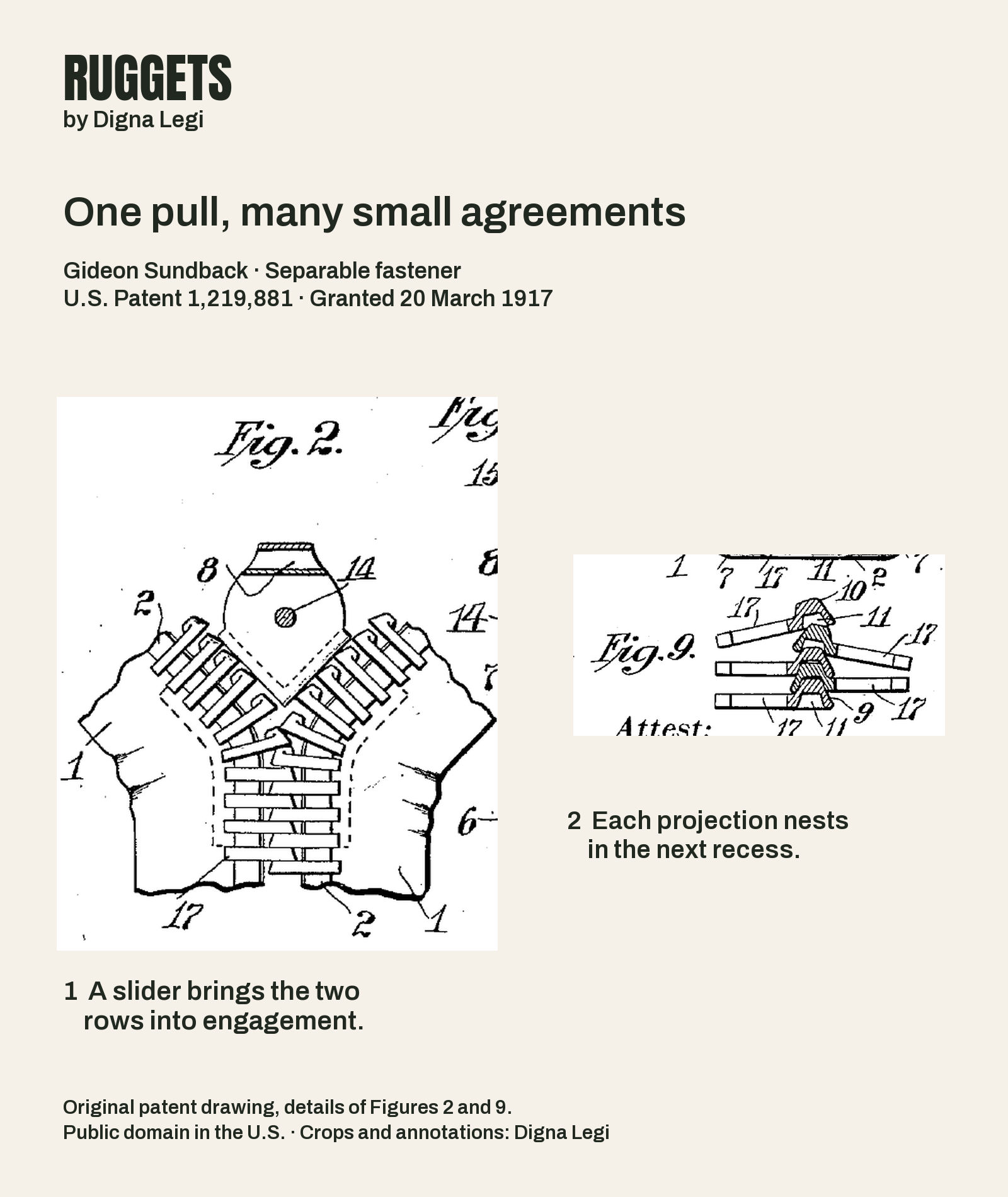
Pulling a zipper feels like one action, but its grip is distributed across many small contacts. In Gideon Sundback’s 1917 separable-fastener patent, identical metal members alternate along two tapes. A rounded projection nests inside the next member’s recess; the slider’s Y-shaped channels guide the rows together or apart. The patent describes how these shapes allow movement without disengagement, combining flexibility with a secure join. This improved earlier fasteners rather than inventing closure from nothing. The design lesson is ours: a simple gesture can depend on carefully constrained relationships between parts. Simplifying what a person must do need not mean simplifying the mechanism that makes it reliable.
Original drawing: G. Sundback, US Patent 1,219,881 (20 March 1917), Figures 2 and 9. Crops and annotations: Digna Legi.
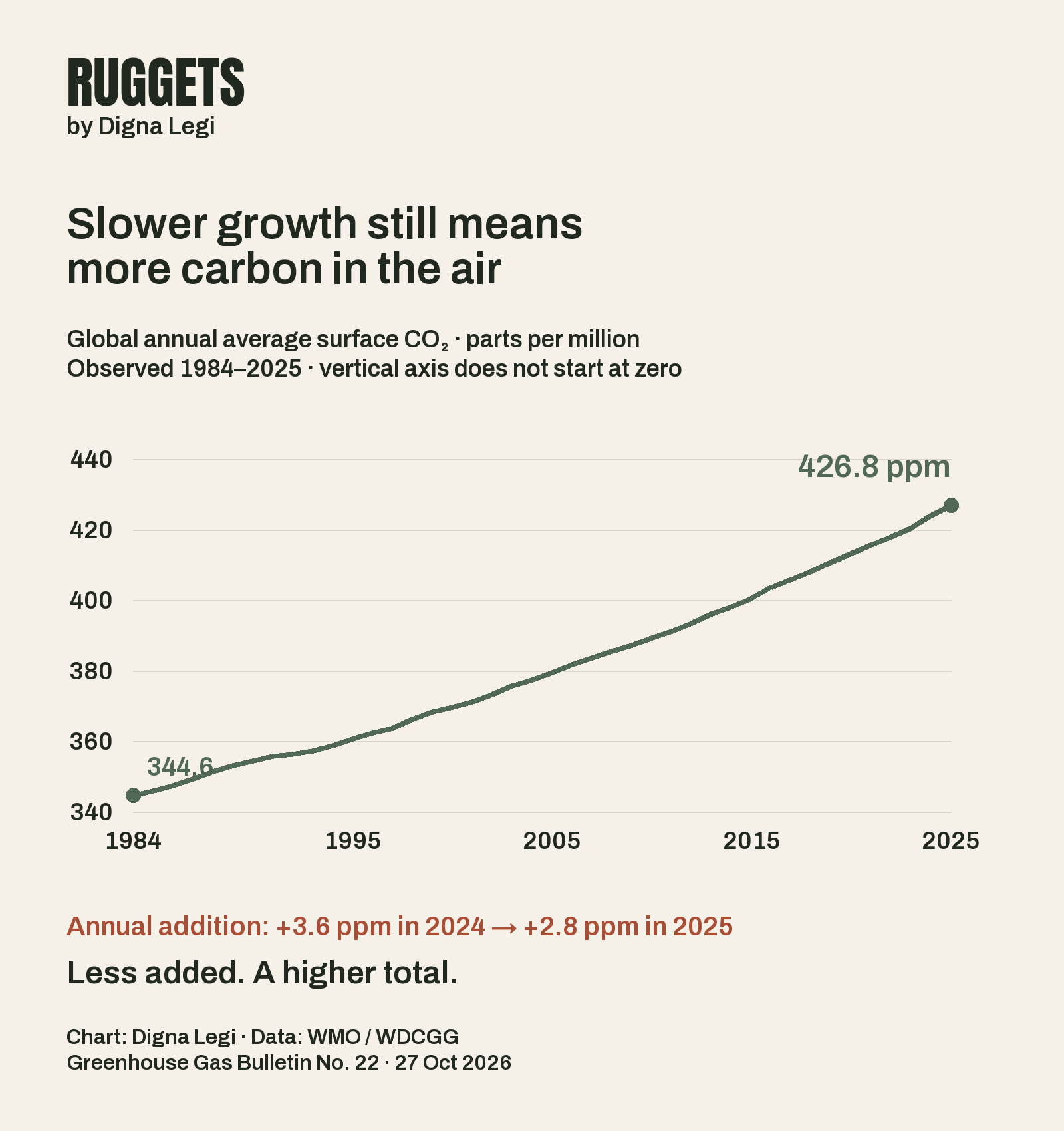
The takeaway. Atmospheric CO₂ reached 426.8 parts per million in 2025. Its annual increase slowed from 3.6 to 2.8 ppm, yet the accumulated concentration still rose. The distinction matters when judging climate progress: slowing an addition is not the same as reducing what is already there. These measurements track the atmospheric stock, not annual emissions. Land and ocean uptake also affect each year’s change, so one slower year cannot establish a lasting shift in the emissions trajectory.
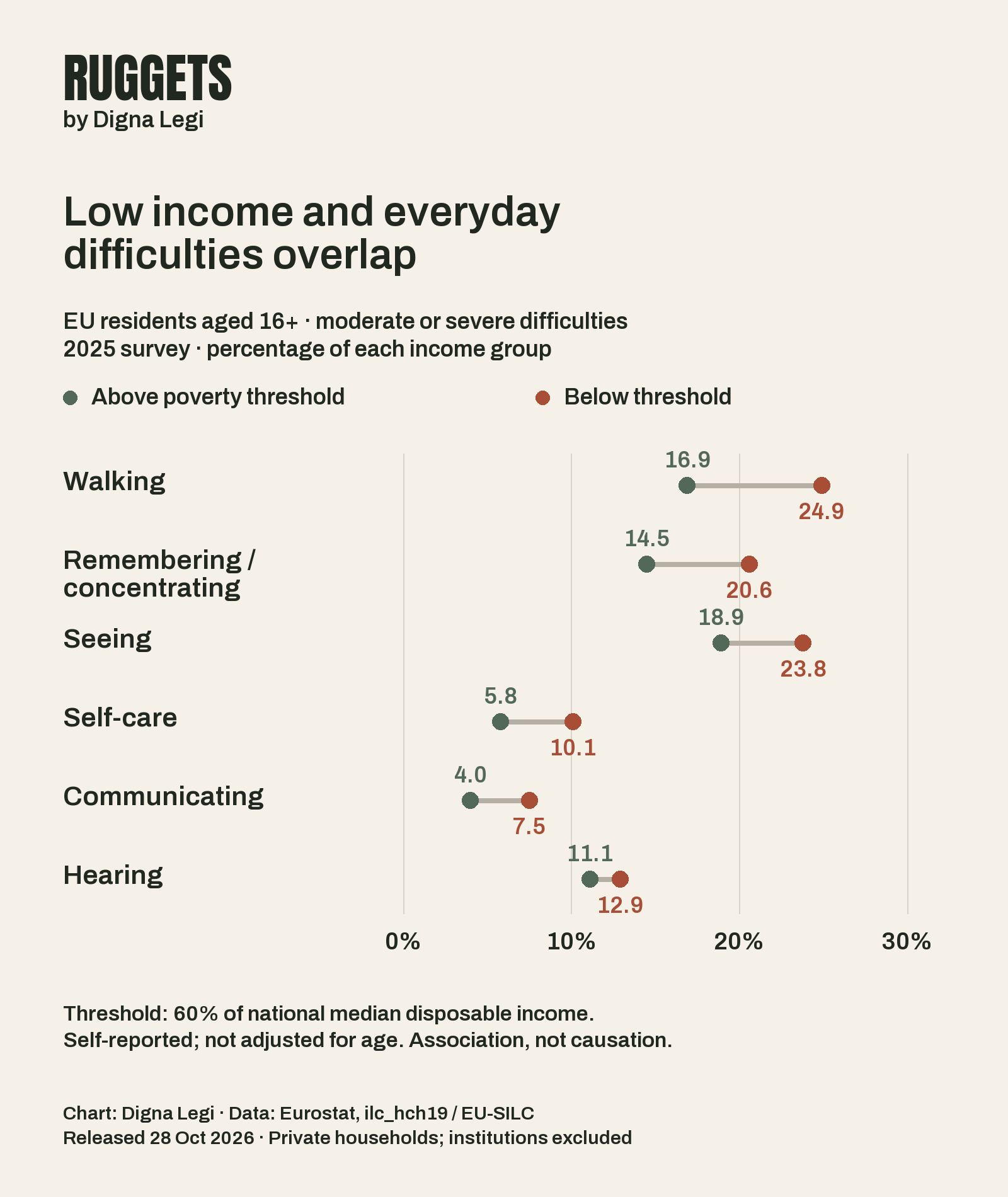
The takeaway. In the EU, 24.9% of people below the relative poverty threshold reported walking difficulties, compared with 16.9% above it. The gap extends to memory, sight and self-care. For anyone designing services, this suggests that financial access and physical or cognitive access should be considered together: making something cheaper does not necessarily make it usable. These are self-reported, unadjusted group comparisons, not proof that low income caused the difficulties; age, health and income can interact.
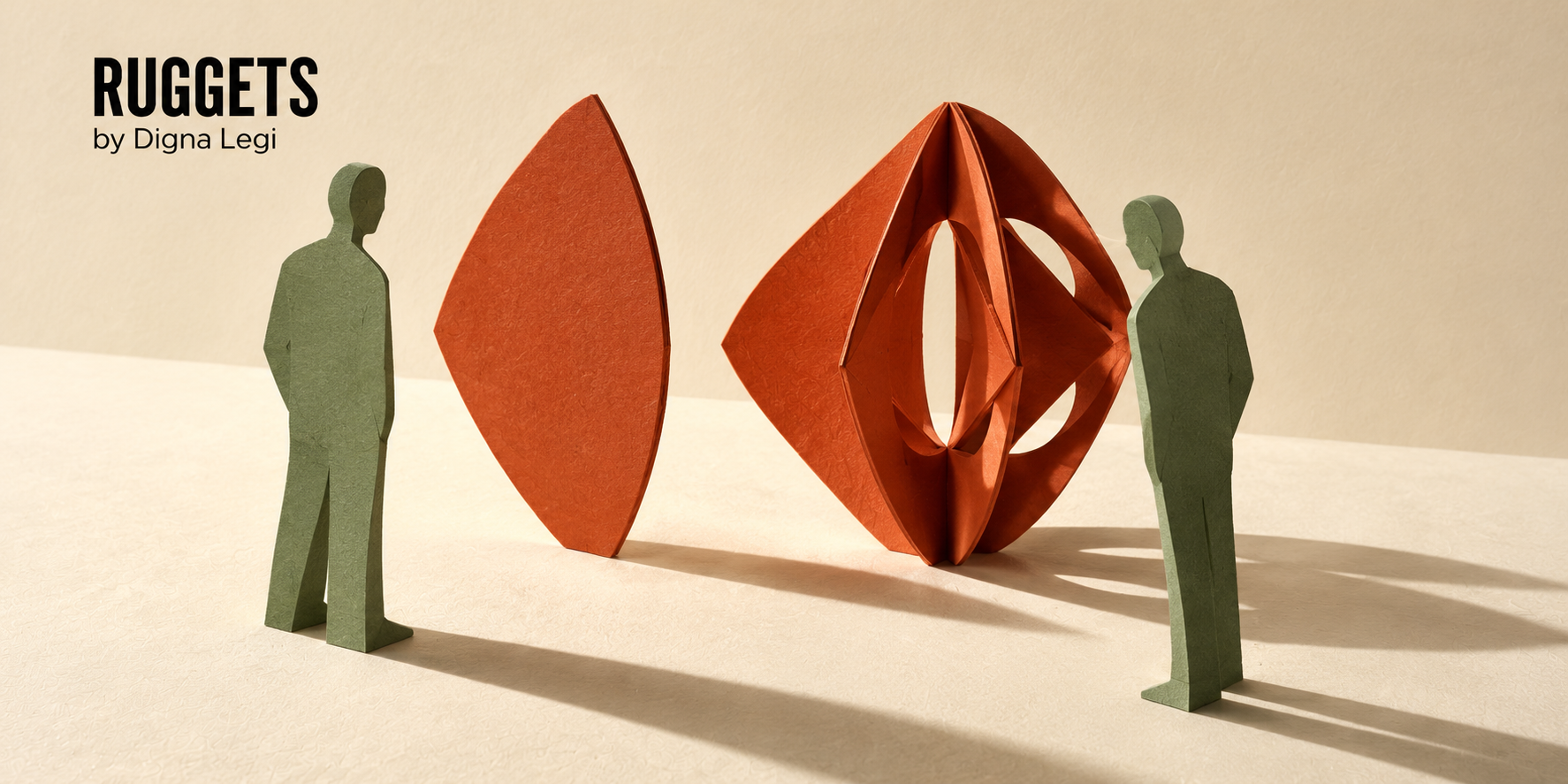
A modern visual metaphor: a familiar outline beside the structure that makes it intelligible.
A friend challenges a conviction you consider settled. You could dismiss the objection to protect a truth, or treat every opinion as equally credible to appear open-minded. Neither response requires you to understand why your belief deserves assent.
John Stuart Mill distinguishes possessing a true opinion from understanding its grounds. Even a correct belief can become a dead dogma when its owner cannot answer serious objections. Disagreement matters not only because an opponent might be right, but because meeting the strongest opposing reasons keeps your own conviction intelligible.
This does not make every objection sound. It makes answering an objection part of knowing why it fails. In this everyday encounter, the task is to hear the difficulty your friend actually raises, rather than defeat a weaker version of it.
What part of your certainty could you still defend if your usual authorities fell silent?