A convincing answer can arrive before the right question. Rob Fitzpatrick explains why interviews cannot substitute for trying a novelty product; Donella Meadows asks us to trace what returns after an intervention. Otis’s elevator patent takes a different approach: it makes room for failure in the mechanism itself. Read them together as three ways to examine a shortcut before relying on it.
01 / Product
Firsthand: Six Years at Vanta, My Reinvention is the Only Constant
First Round Review
≈ 19 min · Current
76/100
Staying at one company can mean changing careers repeatedly, provided the company changes with you. In this First Round Review account, six years at Vanta brought successive marketing challenges: explaining SOC 2 to startups, building a brand, defending a category, moving upmarket, and eventually leading marketing. Accumulated trust made each unfamiliar assignment a more plausible next step.
That mechanism puts conditions on the familiar advice to leave in order to grow. Internal reinvention requires expanding responsibilities, room for first-time mistakes, and recognition of learning already earned. The consequential distinction is between tenure that creates access to riskier work and tenure that simply accumulates. Staying offers this kind of development only when the organization makes those transitions possible.
Beyond synthetic testing: Capturing and replaying real database workloads at Airbnb
airbnb.tech
≈ 9 min · Timeless
87/100
Real database queries do not become a realistic test merely by being replayed. Airbnb captures production traffic at a shared database proxy, but the engineering challenge lies in preserving transaction order, concurrency, and generated identifiers that later queries depend on. Its replay modes separate two purposes: testing how much load a target can tolerate and comparing results across database versions.
Those distinctions determine what an upgrade test can establish. Captured traffic brings relationships that synthetic workloads can miss, yet it represents only the window in which it was recorded. Fixing generated identifiers also leaves the target database’s own identifier generation untested. The value of replay therefore depends on both the behavior it preserves and the boundaries it deliberately draws.
Meadows diagrams filling a glass and earning bank interest to distinguish balancing from reinforcing feedback. Trace the return information path in one decision you keep repeating; a loop diagram still needs its assumptions checked. A plausible loop is a model assumption, not proof of causation. Delays and interacting loops can change whole-system behaviour. The 1977 chalkboard footage is soft.
How does programming language affect token efficiency and correctness?
Dan Luu
≈ 46 min · Current
92/100
Claims that dense or dynamic languages suit coding agents often rest on tasks too small to support the conclusion. Dan Luu’s larger Zstd and Pandoc evaluations complicate that story: language type did not dominate correctness, cost, or time. Popularity appeared more suggestive, but the results still offered no sound basis for ranking individual languages.
The difficulty reaches beyond language choice. Harness bugs, task framing, hidden tests, agent cheating, and peculiar failures can shape what an evaluation appears to measure. Luu describes these as quick, flawed experiments with only two usable larger tasks. Their force is consequently asymmetric: they can undermine confident folklore without supplying a replacement league table. Any broader claim must account for that gap between challenging an explanation and establishing one.
Important organizational decisions can stall even when the analysis is adequate. Operators Handbook locates the friction in unclear ownership, surprised stakeholders, poorly framed choices, and commitments that remain open to renegotiation. Its proposed discipline begins before the meeting: identify the accountable decision maker, align affected teams, sequence fundamental tradeoffs, and arrive with a clear recommendation.
The written rationale matters after agreement because execution can otherwise be pulled back into the debate that preceded it. This makes decision-making a problem of preparation and continuity as well as judgment. But the author reserves this structure for high-stakes choices; routine decisions do not need the same machinery. The practical tension is how to secure consequential commitments without turning ordinary judgment into formal process.
Linguistics, Style and Writing in the 21st Century - with Steven Pinker
Pinker rewrites the same passage two ways. A mechanical ban on passive voice breaks the messenger-to-baby-to-shepherd chain; the comparison makes a practical editing decision visible. This is a heuristic for English explanatory prose. It does not justify hiding agency or removing genuine uncertainty.
Arabic has four words for sadness. Philosophy explains why
Psyche
≈ 8 min · Current
91/100
Arabic terms for distress can distinguish experiences that a generic label of sadness leaves unresolved. The Psyche account describes huzn, ghamm, ka‘aba, asaf, and diq alsadr as locating suffering through time, bodily feeling, spirit, memory, regret, and theological inheritance. These distinctions challenge translations, sentiment analysis, and diagnostic labels that compress different experiences into a shared category.
What disappears in that compression can matter to how suffering is interpreted, not merely to how precisely it is named. Islamic philosophy offers resources for retaining those differences alongside contemporary methods. The claim is not that richer vocabulary replaces evidence-based treatment, neuroscience, or computational analysis. It is that those methods can lose interpretive distinctions when their categories become the only available account of distress.
A dilemma about success, freedom, or fear can become a philosophical problem rather than only a problem of adjustment. In The New Yorker’s account of philosophical counselling, practitioners use concepts, traditions, and readings to examine clients’ assumptions about their lives. The practice emerges as a hybrid, with considerable variation in what counsellors do and how they prepare.
That variation complicates the appeal of practical self-examination through ideas. Observed sessions and practitioner accounts support a meaningful practice, but they do not establish a uniform method. Concerns about referral judgment and the American Philosophical Practitioners Association’s brief certification process leave its boundaries unsettled. The stakes include recognizing which dilemmas philosophical inquiry can address and when a client needs care beyond it, particularly for severe psychiatric conditions.
[The Mom Test] How to research a product nobody actually needs
The Mom Test author explains a boundary of his own method: conversations can uncover context, but a novelty product needs an experience people can actually try. Distribution remains a separate question. The distinction is not a universal binary: many products mix utility and enjoyment. This is reasoned advice with examples, not a controlled experiment or demonstrated interview.
How we could save petabytes of cache storage with Zstandard and Pingora
Cloudflare Blog
≈ 7 min · Discovery
81/100
Cloudflare’s cache-compression prototype changes the stored representation of an asset while preserving the bytes clients receive. Eligible uncompressed text is encoded with Zstandard when it enters the cache, then decoded before delivery. Encoding is paid once at cache fill; a smaller representation can save storage and inter-data-center bandwidth as the object is reused.
The attraction lies in that repeated reuse, but the measurement has a narrow basis. Roughly 2.8x compression came from deliberately compressible assets, not a representative sample of everything Cloudflare caches. Already-compressed media falls outside the favorable trade described here, and a broader corpus is needed before extending the ratio across the fleet. The prototype makes a concrete savings mechanism visible while leaving its overall scale unestablished.
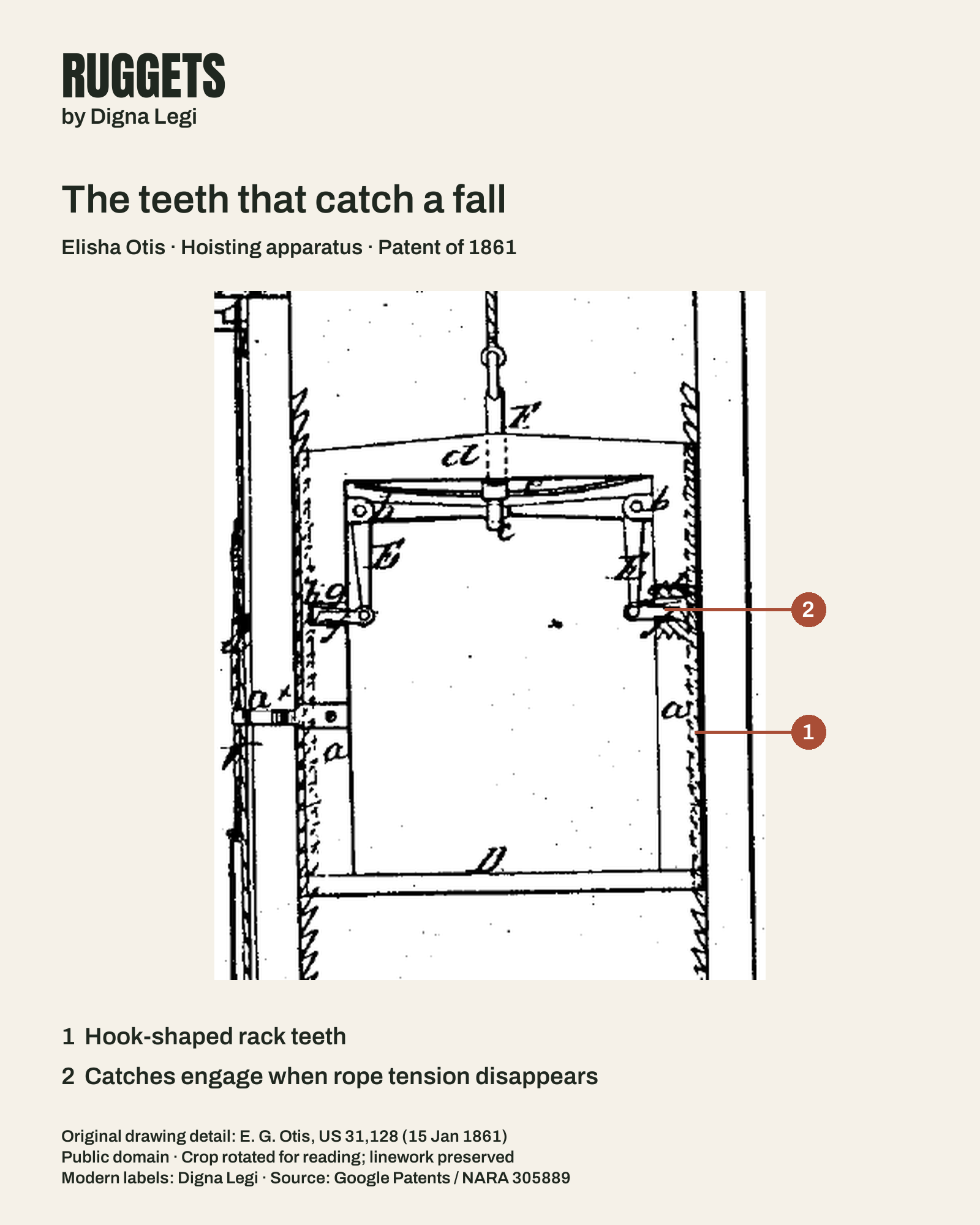
Look at the upward-facing teeth beside the platform in Elisha Otis’s 1861 hoisting patent. They are not there to lift it. If the lifting rope breaks, springs push catches into those teeth; the load then helps lock them together instead of forcing the supports apart. Otis’s claim describes a response to a specific failure, not a promise that failure cannot happen. Our reading: a useful safeguard changes what the system does when its main support disappears. That distinction travels beyond elevators, but the patent alone does not establish how reliably this mechanism worked in service.
Drawing detail: E. G. Otis, US 31,128 (1861), reproduced from Google Patents PDF, page 1. Archival reference: U.S. National Archives, 305889. Crop, rotation and modern labels: Digna Legi.
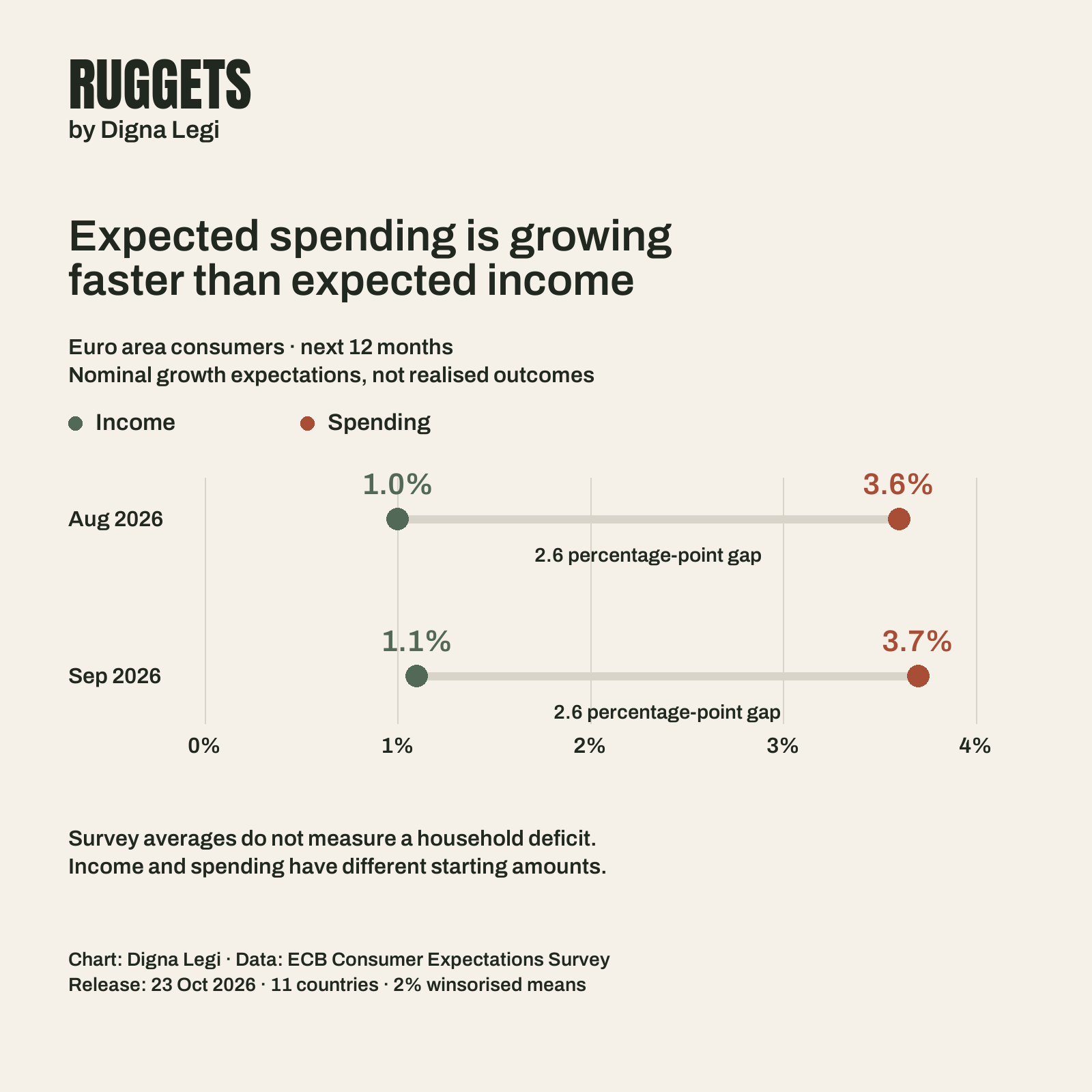
The takeaway. In September, euro area consumers expected spending to grow by 3.7% over the next year, against 1.1% for income. The 2.6-point gap was unchanged from August. That comparison is a reason to examine both sides of a household budget rather than treating an expected pay rise as extra room to spend. These are survey averages, not realised outcomes; different starting amounts and household circumstances mean the gap cannot be read as a forecast deficit.
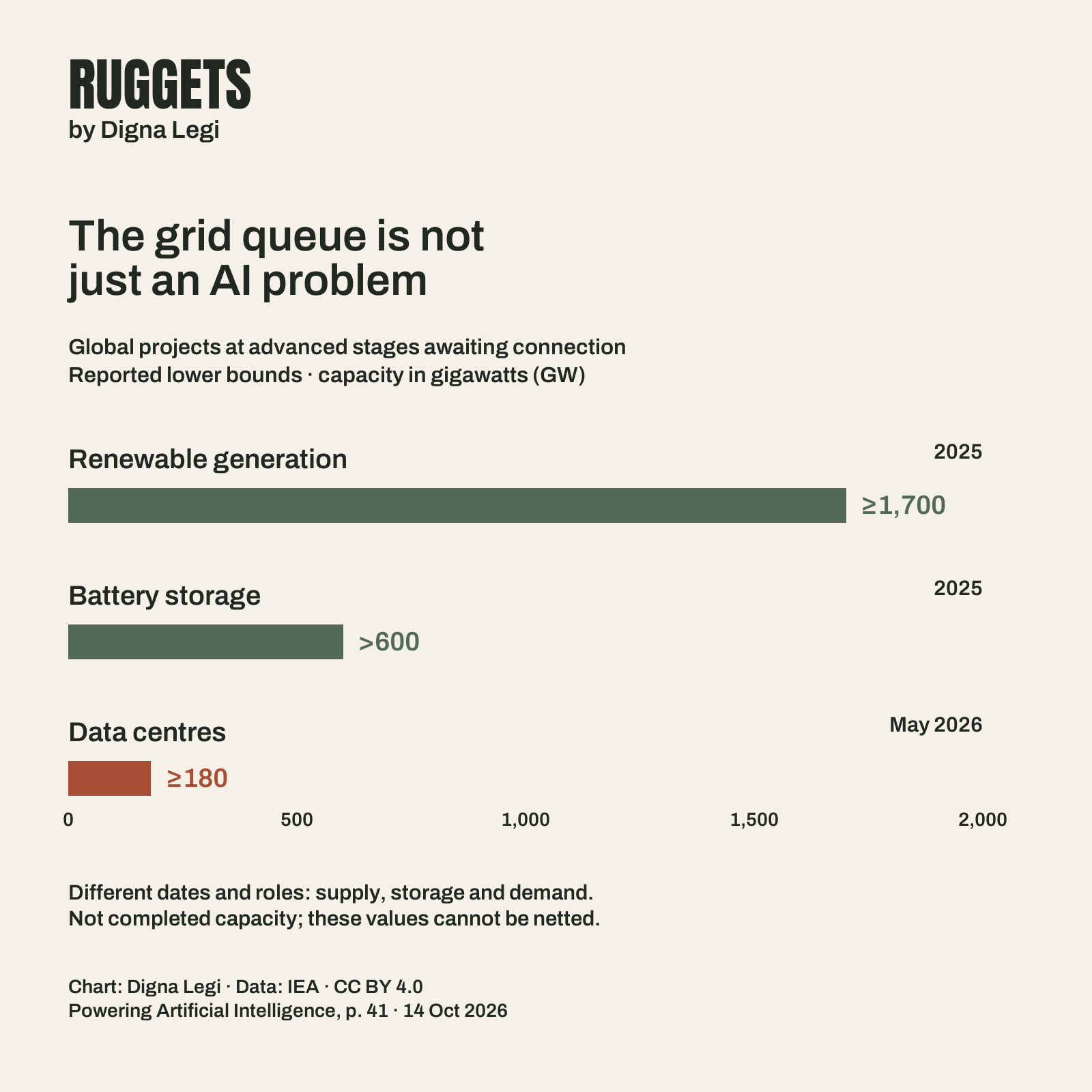
The takeaway. The IEA reports at least 1,700 GW of renewable projects and more than 600 GW of batteries waiting for grid connections, alongside at least 180 GW of data centres. The constraint is therefore on connecting supply as well as demand: announcements of new generation alone do not tell us when electricity becomes available. These are lower bounds for advanced projects, measured at different dates; generation, storage and consumption capacities are different things and cannot simply cancel one another out.
A modern visual analogy for attending to particulars, not a diagram from Aristotle.
A colleague misses a deadline while caring for a sick parent. A deadline protects cooperation, but enforcing it without considering the circumstances can defeat that purpose. Equal treatment alone does not establish that people have been treated justly. Compassion also needs judgment: someone else must carry the unfinished work.
Aristotle’s practical wisdom, phronesis, joins attention to particulars with concern for living well. Cleverness can find efficient means to a bad end; good intentions can fail through poor judgment. Acting well requires both a worthy purpose and a truthful understanding of the situation.
Here, an extension might express fairness, provided responsibility for the remaining work is openly shared. The lesson is not that every rule admits a convenient exception. Rules guide judgment; they cannot relieve us of responsibility for exercising it.
Are you applying the rule to serve its purpose, or using it to avoid the responsibility of judging?