
RUGGETS / ISSUE 63Explore this issue ↓

READ. THINK. WATCH.

A closer look.

Seven articles. Three videos. Two charts. Five AI developments. One philosophical idea to sit with.

Start reading ↓
A terracotta caliper measures a small black stone casting a large shadow; RUGGETS by Digna Legi.
THE SELECTION

A weekly selection by Ratip.

7 reads + 3 talks + 2 charts
01

Seven worth reading

A small collection. A wider view.

01 / Product

TBM 437: Tokens, Hours, Points, and Other Curious Proxies

The Beautiful Mess — John Cutler

≈ 12 min · Current

89/100

Tokens can make an AI investment look measurable without making its return explainable. John Cutler places them alongside hours, capacity, and story points: convenient input meters that can stand in for value without establishing how value arises. His distinction is between counting a cost and defending the causal theory that makes that cost worthwhile.

For exploratory, interdependent work in product, software, and AI, that distinction changes what an investment case must establish. What demand does the spending serve, what capability does it create, and which bottleneck does it move? A precise meter leaves those assumptions untouched. The consequential uncertainty sits in the connection between the counted input and the outcome—and in what evidence would change the investment.
02 / Engineering

Google - The Anatomy of a Large-Scale Hypertextual Web Search Engine, 1998

infolab.stanford.edu

≈ 42 min · Timeless

86/100

In their 1998 search-engine paper, Sergey Brin and Larry Page argue that collecting more web pages cannot by itself produce better search. A huge, uncontrolled, commercial web requires machinery that can distinguish authority and context. Their proposed Google system combines PageRank, anchor text, proximity, visual presentation, and storage-conscious architecture, prioritizing the quality of the first few results over returning every relevant page.

That priority makes the paper historically revealing: search quality becomes a problem of ranking under difficult conditions, with an explicit tradeoff between precision and recall. But the authors leave a complete user evaluation outside its scope. The tension lies between a concrete design for better results and the limited evidence then available to establish how well it worked.

▶ WATCH 01 / 03

Michael Alley / Science Communication Lab

Make the slide prove one sentence

A sentence headline gives you a test for deciding which evidence belongs on a slide. Alley turns an aquifer diagram into support for a specific claim. Try stating the conclusion of one slide in a sentence, then check whether every retained element helps establish it. The short passage demonstrates the first principle of his approach. The supporting experiment changed several design features together; it does not isolate the effect of sentence headlines. This is guidance for spoken scientific presentations, not a rule for every document.

Watch on YouTube ↗

Selected 14:53–17:50 · Full talk 25:56

03 / AI

Talking Shop

boxofamazing.substack.com

≈ 9 min · Current

88/100

Rahim Hirji sees a problem in asking graduates to supervise AI output before they have developed the judgment to challenge it. His analogy is the purchased commission: responsibility and standing can arrive before capability. Against that route, the Woolwich Arsenal example distinguishes announcing desirable traits from building institutions where people can practice, fail, and earn recognition.

The stakes extend beyond whether newcomers can produce acceptable work with models. A training route must develop the judgment that supervision already assumes, while giving that development credible status. EY’s residency brings those demands into focus, but Hirji’s argument does not establish whether it will succeed or avoid becoming a lower-status alternative to conventional graduate entry. Institutional design carries the burden that a list of desired qualities cannot.

04 / Leadership

Good Product Manager, Bad Product Manager

a16z.com

≈ 3 min · Timeless

90/100

Accountability gives “Good Product Manager, Bad Product Manager” its organizing distinction. Strong product managers own market knowledge, product success, targets, and a winning plan. The contrast concerns leverage more than effort: clarifying what to build, creating reusable materials, and anticipating failures allow a team to act, while excuses, informal opinions, firefighting, and unmanaged feature pressure absorb its attention.

Yet the author introduces this as an old memo and questions its continuing relevance to the role. That qualification matters when assessing its demanding account of ownership. The memo makes a sharp distinction between responsibility for outcomes and coordination of activity, but its historical distance leaves room to examine which expectations still clarify the job and which require reconsideration.

▶ WATCH 02 / 03

Bret Victor / Rui Oliveira · CUSEC recording

Inventing on Principle

A live preview can still hide the behavior you need to understand. Replaying identical inputs and showing the trajectory reveals what a change actually does. A small platform game makes the distinction visible: changing the bounce, replaying the same controls, then drawing the path. The four-minute demonstration offers a concrete criterion for evaluating a tool: can you inspect the behavior that matters? The replay demonstrates one set of inputs, not correctness for every possible interaction. The old recording is soft; use a larger screen for the code.

Watch on YouTube ↗

Selected 10:26–14:40 · Full talk 54:19

05 / Philosophy

The Internet Classics Archive | Principal Doctrines by Epicurus

classics.mit.edu

≈ 8 min · Timeless

84/100

Epicurus ties pleasure to a limit: once bodily pain, want, and mental alarm are removed, accumulating further delights is no longer the governing aim. Reason, natural inquiry, friendship, and justice support happiness by reducing fear and insecurity. On this account, unnecessary desires, fame, unjust advantage, and cosmic superstition can unsettle the very security they appear to offer.

The same practical test gives justice a conditional authority. A law or compact matters because it prevents harm in mutual association; its usefulness depends on the circumstances. This makes security both an ethical aim and a standard against which arrangements must be judged. The doctrines connect a restrained account of pleasure with a demanding examination of what actually lets people live without fear.

06 / Life

Extreme Programming 1999->2026

Manager.dev

≈ 13 min · Current

81/100

Extreme Programming remains useful, the Manager.dev author argues, because its structure reaches beyond pair programming or test-first development. Values establish direction, practices make those commitments observable, and principles connect the two. That relationship supplies a way to judge software work when AI puts pressure on architecture, review, and expectations about how easy development should become.

The author applies this framework to oversized generated pull requests, review bottlenecks, architecture bloat, and eroding role boundaries. These are experienced patterns and interpretive judgments, rather than measured claims about their prevalence. Their significance lies in the gap they expose between producing code and sustaining the values that should guide its production. XP’s relevance rests on whether its principles can make that gap concrete enough to assess.

▶ WATCH 03 / 03

Grant Sanderson / 3Blue1Brown

Bayes theorem, the geometry of changing beliefs

Evidence filters possibilities unevenly. The updated probability is your hypothesis’s share of the possibilities left standing. Sanderson builds the rule from counts and areas. Sketch the evidence-compatible cases before trusting a conditional-probability claim; a low base rate can outweigh a suggestive description. The example's personality likelihoods are assumptions, and the prior depends on how the person was sampled. The later Linda-problem aside is outside this passage and overstates how consistently a change of wording eliminates errors.

Watch on YouTube ↗

Selected 3:24–10:14 · Full talk 15:10

07 / Product

Why retention is so hard for new tech products

Andrew Chen

≈ 15 min · Discovery

78/100

Andrew Chen argues that retention in new tech products is largely shaped by product category, user need, and natural frequency of use. Early cohort behavior often reveals a trajectory that notifications, onboarding changes, and A/B tests cannot substantially repair. Weak day-one or month-one retention therefore points, in his account, toward a deeper mismatch than a collection of tactical defects.

His claim concerns patterns in startups and internet products, with exceptions for hardcore products, network effects, revenue-expanding business software, and genuine category creation. Those qualifications matter: improvement may require a major product reframing, or a business that grows through the users who remain. The stakes lie in distinguishing a retention problem that admits refinement from one that challenges the product’s underlying premise.

02

Two charts worth understanding

Findings, lessons and limits.

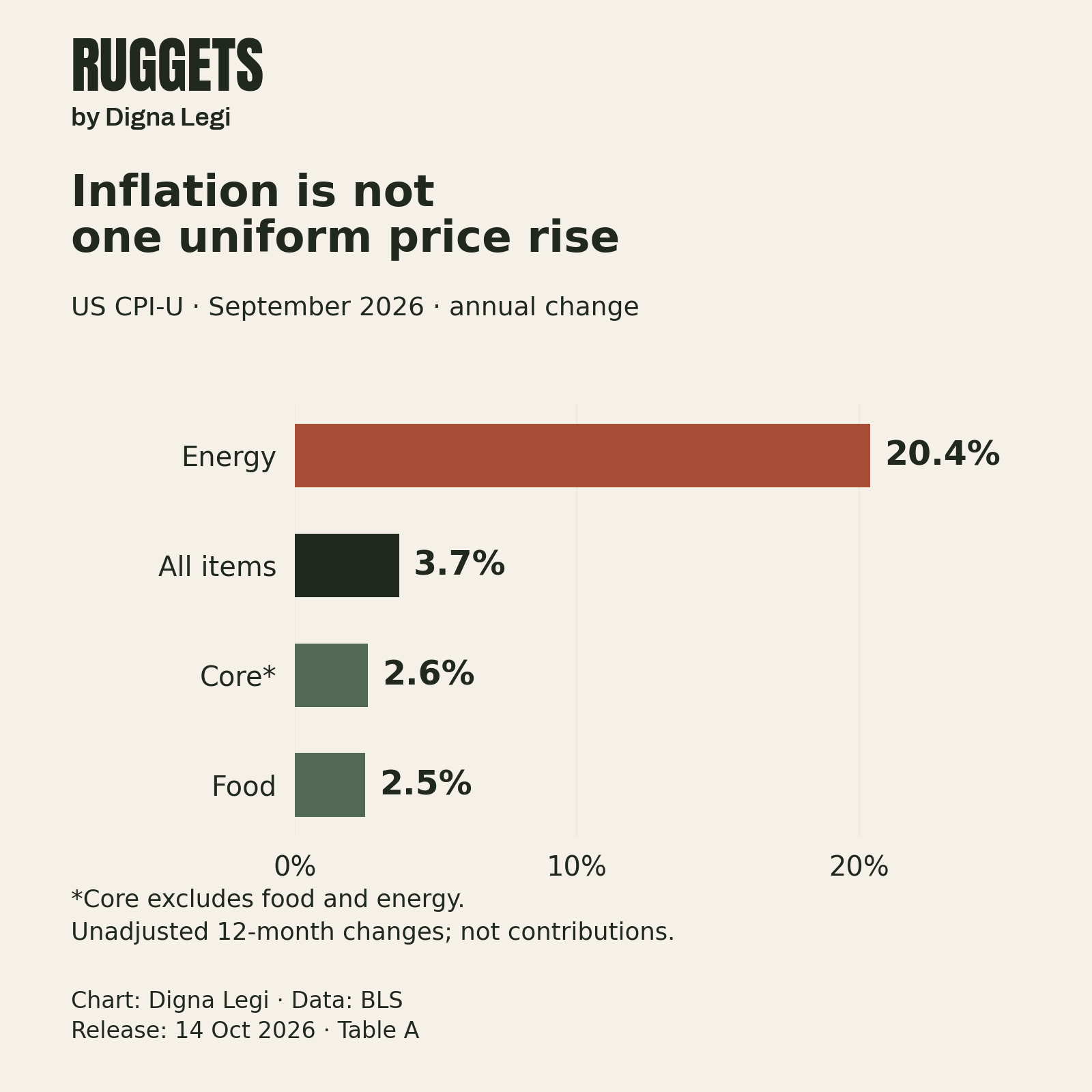
Inflation is not one uniform price rise

US annual CPI inflation in September 2026: energy 20.4%, all items 3.7%, core excluding food and energy 2.6%, and food 2.5%. Bars start at zero.

U.S. Bureau of Labor Statistics · Published 2026-10-14
Data: September 2025–September 2026 · Source data ↗

The takeaway. US consumer prices rose 3.7% over the year to September, but energy rose 20.4%, compared with 2.6% for the basket excluding food and energy. The practical lesson is to examine exposure before relying on the headline: a household that spends more of its budget on energy can face a very different squeeze. These bars show price changes, not contributions to total inflation; categories have different weights, and the national urban average does not describe every household.

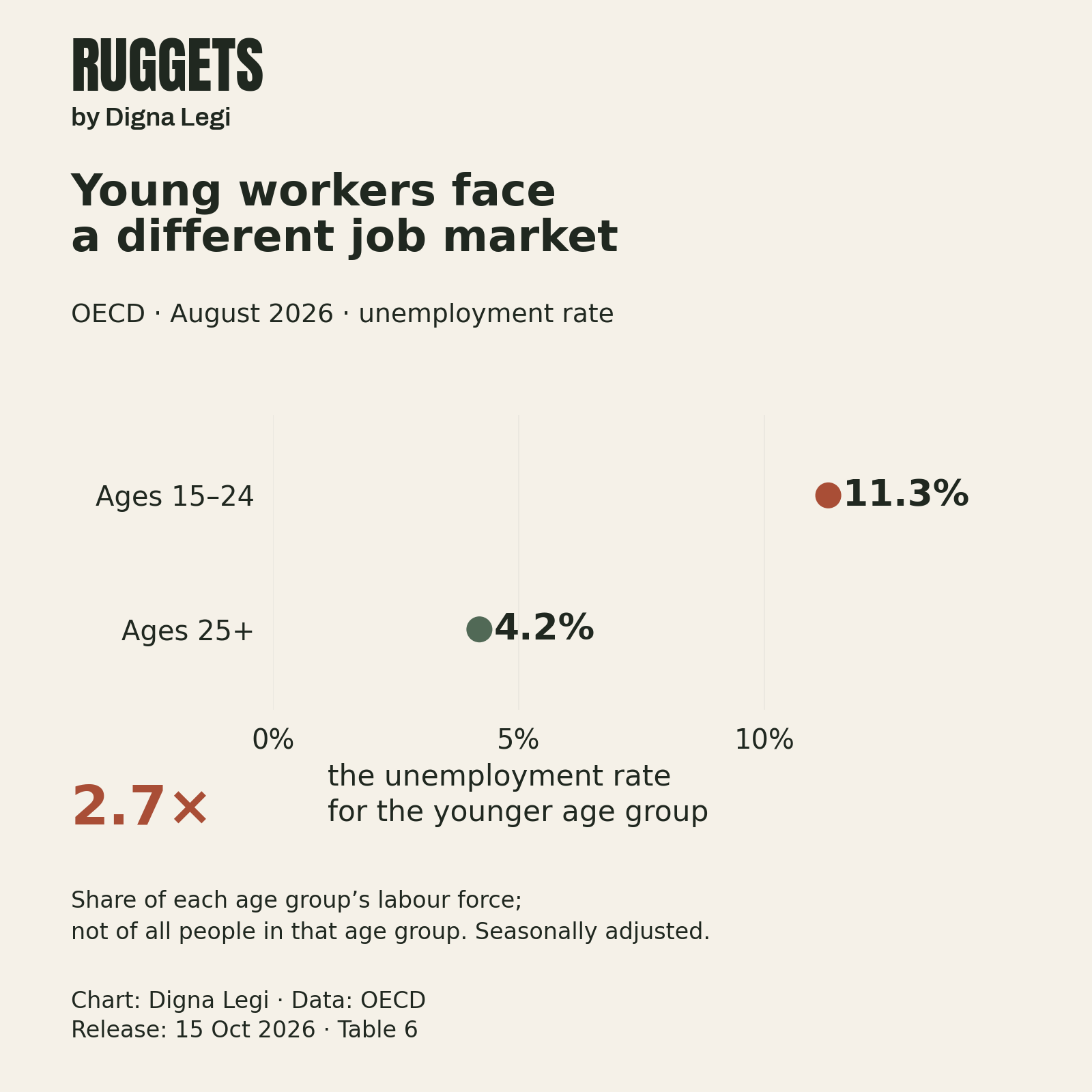
Young workers face a different job market

OECD unemployment in August 2026: 11.3% of the labour force aged 15–24, compared with 4.2% aged 25 and over. The younger group’s rate is about 2.7 times the older group’s. Dots share a percentage axis starting at zero.

OECD · Published 2026-10-15
Data: August 2026 · Source data ↗

The takeaway. In August, OECD unemployment was 11.3% among 15–24-year-olds in the labour force, versus 4.2% among those aged 25 and over. For someone starting a career, the useful question is not simply whether the economy has jobs, but which jobs are accessible at their stage. Assess local entry opportunities before treating a difficult search as a personal failure. This comparison cannot isolate first-time jobseekers, explain the gap or establish a trend; the OECD aggregate also carries forward missing countries’ latest observations.

Five AI developments to know

One idea to sit with

Epicurus: What would be enough?

Editorial illustration: bread and water, a fig dessert, and an elaborate cake staged before empty chairs suggest nourishment, pleasure, and imagined admiration.
An illustration of three motives, not a ranking of foods. Luxury can be enjoyed without needing an audience.

Epicurus distinguishes desires that are natural and necessary, natural but unnecessary, and grounded in empty beliefs. Hunger needs relief; a lavish dinner offers a variation on eating; needing everyone to admire your dinner can create a demand with no clear stopping point. The distinction concerns what a desire promises and what satisfying it costs, rather than a list of forbidden objects. An expensive meal can be enjoyable without becoming necessary to your happiness. Epicurus treats pleasure as good, while warning that some pleasures bring greater trouble afterward. His practical test is whether a choice supports bodily ease and peace of mind, including when the luxury is unavailable.

Think of one purchase you are considering: what need would it meet, and would meeting that need actually let you stop wanting more?

Source: Epicurus, Letter to Menoeceus